
Good news!
Great news comes from the Asian Committee of ICPC that Team Aegleseekers from JNU has officially entered the 46th ICPC global finals.
Team Introduction
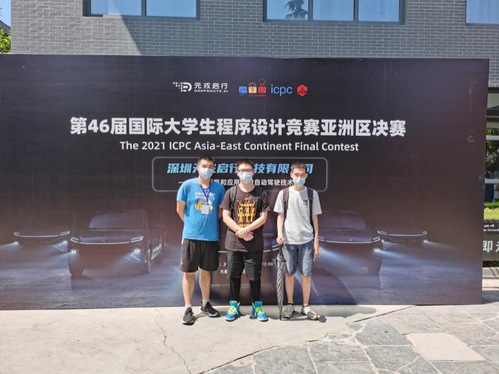
Aegleseekers entered the global finals was teamed up by Wen Jianwei from J-BJI information and computing science 2020 cohort, and Mai Jun and Wen Yinhua from School of Information Science and Technology.
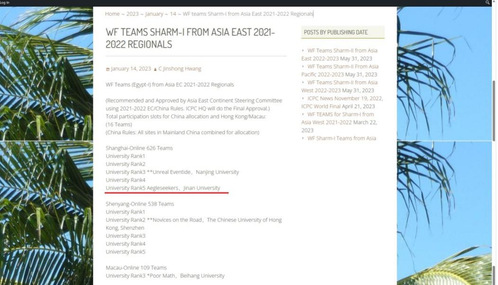
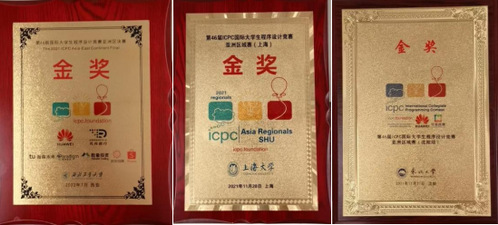
Earlier, team Aegleseekers won the first prize in the Guangdong Provincial Competition of China Collegiate Programming Competition (CCPC). In the 2021 ICPC Asian regional qualifiers, the team won gold medals in 3 consecutive regional competitions (Shenyang, Shanghai, and Asian finals), and won the 7th place and the 5th place among 626 teams in Shanghai Division, successfully entering the global finals.
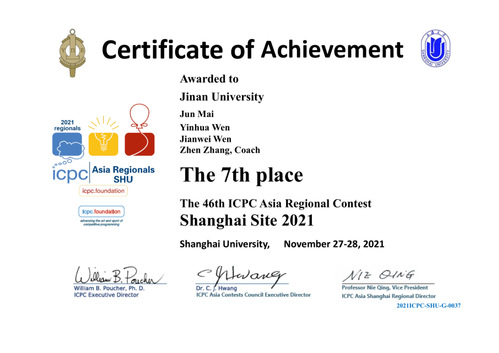
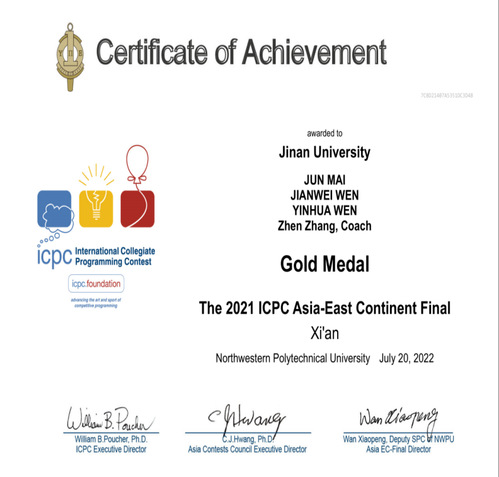
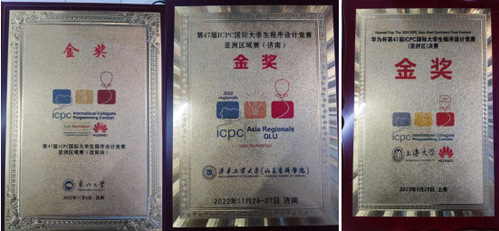
Experience
WEN Jianwei:
ICPC is an algorithm competition in which teams of up to three people use programming to solve 12 algorithm problems within five hours, with a strictly defined input and output format and scale, using an automated evaluation set, and finally ranking according to the number of problems solved and the time used. The period can be submitted continuously, but the wrong submission is recorded as half an hour of additional use time.
My algorithmic competition experience began in high school, and I got further learning and training in university, and deepened the unity and cooperation with my teammates. In the first semester of my sophomore year, I won the gold medal of the ICPC and the top three results in the Shanghai competition area. Later, we participated in the Asian Finals and also won the gold medal. A few months ago, the ICPC Organizing Committee selected our team to participate in this year's World Finals in Egypt based on the results achieved in the 2021 event.
The fact that we entered the ICPC World Finals is obviously a credit to my teammates. We are good at division of labor and crossover in different types of problems. We help each other in training and cooperate with each other in competitions, and have achieved very good results.
In addition, there are our competition coaches and a group of like-minded partners in ACM association of JNU, and our training system has become more standardized and scientific over years with the success of relevant competitions.
The amount of ACM training in college was very large, and even though my three teammates and I had a fairly basic algorithmic competition in high school, we still conducted simulation training several times a week (at least five hours each time). Besides, after each simulation training, we will also carry out continuous reflection and orientation training on weak points, even in the maintenance stage, the investment time is dozens of hours per week.
Frankly speaking, the algorithm competition is a stage to improve ourselves, but the ICPC series is not necessarily a very cost-effective competition goal without solid foundation. Students interested in computer science and algorithm competition may start with the Blue Bridge Cup level competition.
Introduction to ICPC
The ICPC is the world's oldest, largest and most prestigious programming competition, also known as the Olympic Competition of computer programming, and is held annually. In this competition, there would be 3 players in a team, together using 1 computer, to write a program to solve 10 to 12 problems within 5 hours, and the team which solved the most problems with the least time won. This competition is recognized as the world's largest and highest level of global college student programming competition, in which the world's computer industry stars of hope have gathered in the previous games, and each year the 500 players who entered the global finals were the world's top students of computer science. Therefore, the competition is highly respected by internationally renowned universities and top international computer companies.
This year, ICPC has attracted more than 50,000 students from more than 3,000 universities in 111 countries around the world, and 170 teams were selected to advance to the global finals through more than 400 regional trials, and the competition process was very intense. Only teams ranked top 5 in the regional competition could have the chance to qualify for the global finals. Only 16 universities entered global finals this year, including Tsinghua University, Peking University, Zhejiang University, Shanghai Jiaotong University, Nanjing University, besides our school. In Southern China, only our school, together with Sun Yat-sen University and Hong Kong University, were global finalists.
J-BJI attaches great importance to high-level discipline competitions, as they stimulate students' learning interest and potential, create diverse and open learning methods, and enable students to constantly understand the development characteristics and trends of their profession, industry, and field through team cooperation and practical research.
By constantly improving the quality of competition education, J-BJI laid a good foundation for the future development of students.
Undoubtedly, there were repeated setbacks and lots of training behind their success, but their love and dedication to programming will last forever.
Once again, congratulations to the winning team!
And we also look forward to seeing more students participate in the ICPC.


